TL;DR
- —Everyone wants integrated marketing communications. Most organisations aren't set up to deliver it.
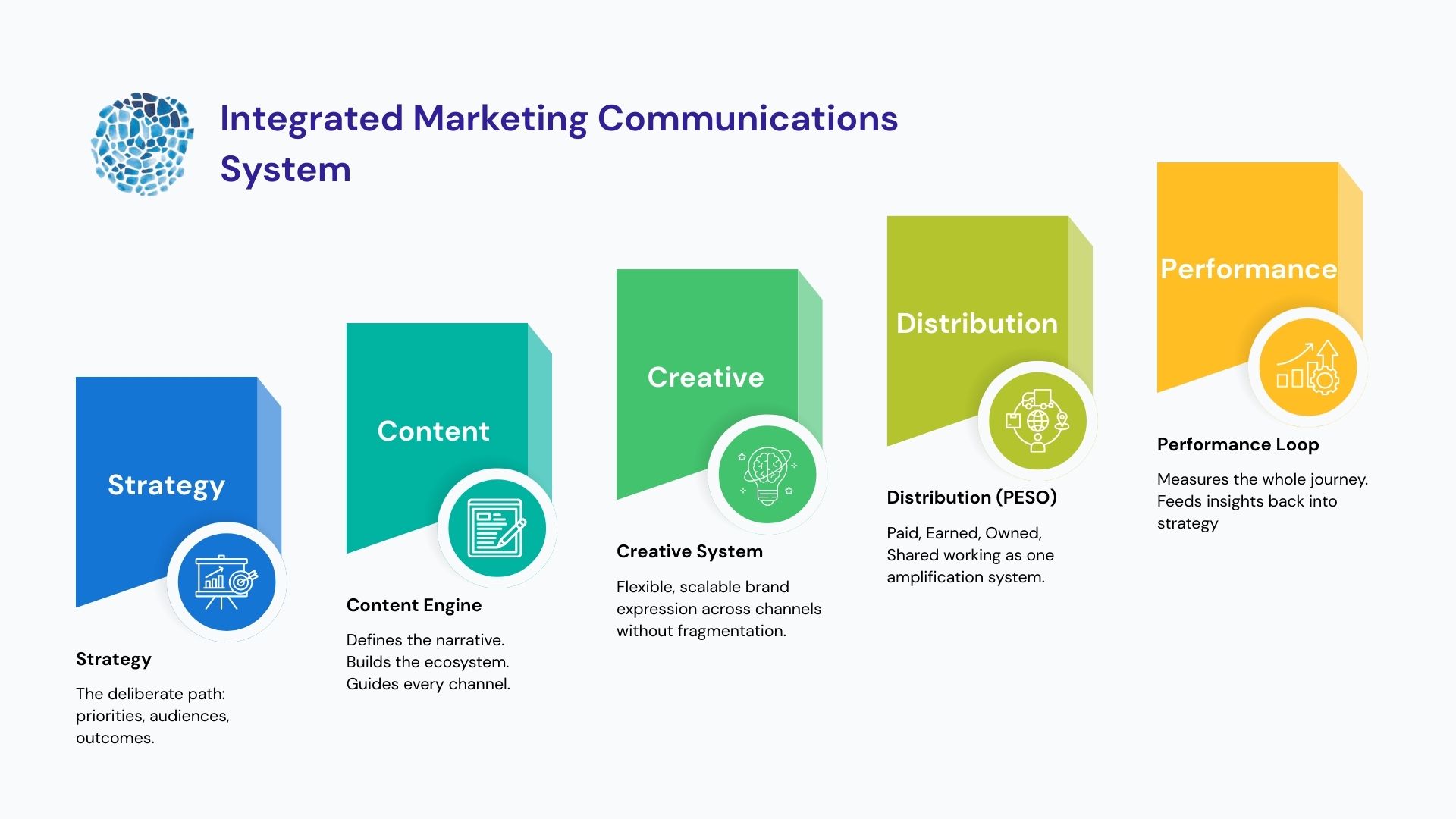
- —True IMC needs a shared operating system: Strategy → Content → Creative → Distribution → Performance.
- —And that system depends on five non-negotiables:
- 1.A strong content engine that defines the narrative and runs across a full content ecosystem.
- 2.Creative capability that can flex across channels without fragmenting the brand.
- 3.Digital + distribution that uses PESO intentionally — not in silos — to actually get the story seen.
- 4.Performance & analytics that measure the entire journey.
- 5.Strategy + discipline to hold the whole system together through timing, alignment, and repeatable execution.
When these five pieces work as one, organisations stop producing disconnected outputs and start delivering one story — consistently, deliberately, and at scale.
Every organisation wants one brand, one message, one unified customer experience. Yet few are actually set up to deliver it.
Integrated Marketing Communications (IMC) sounds simple in theory. Yet most teams operate in silos: content responding to disparate asks, digital trying to keep every stakeholder happy, creative chasing the "one idea to rule them all," and performance looping back only after the campaign has already shipped.
The challenge is that integration requires a shared operating system — a disciplined, cross-functional way of working that connects strategy, content, creative, digital, and performance. Without that system, IMC stays fantasy. Here are the five non-negotiables every integrated marketing communications organisation needs.
Non-Negotiable #1: The Content Engine
Content — good content — is the backbone of any IMC strategy. It's not about volume, but about producing quality content that can lift the weight of every other function: creative, digital, performance.
A real content engine defines the brand narrative, the messaging framework, and the channels where the story will live. A content engine also functions within a content ecosystem. It leverages content created by the brand, the leadership, subject matter experts, and employees, collaborators and other stakeholders — all to reinforce the same story across all channels, from the website to social channels, events online and offline, and even email newsletters.
A good IMC strategy makes a deliberate choice on what story to tell, who should tell it, where it belongs, and how it scales. When the content engine is weak, teams default to inconsistent asks, inconsistent messaging, duplicated assets, and campaigns with no spine.
Non-Negotiable #2: Creative Capability
Many organisations still chase the one hero campaign idea they hope will carry everything. While businesses need to be consistent in their messaging, IMC is about building a flexible creative system that can travel across channels without losing its coherence.
This starts with a strong brand identity system: visual principles, tone, motion, templates, and modular design that can adapt quickly. Once that foundation exists, creative can finally do what IMC needs it to do: flex without fragmenting. The same story can be expressed in different ways, but it always feels like the same brand.
Channel-native execution is the real nuance here. A hero content piece on LinkedIn can work well there, but it needs to behave differently on Instagram, differently in an EDM header, and differently on a landing page. Each platform has its own culture, norms, and attention patterns. Creative capability is the discipline of translating one narrative into channel-specific expressions without changing the story.
When this is done well, campaigns scale more easily, production becomes faster, channels start to amplify each other, and audiences recognise the brand instantly.
Non-Negotiable #3: Digital and Distribution
"If content is king, distribution is queen. And honestly, she's the one who wears the pants." You can spend weeks crafting brilliant content, navigating approvals, polishing every line — but if it isn't seen, what's the point?
The simplest way to think about distribution is the PESO model: Paid, Earned, Owned, Shared. It works best when you use it as a system, not a set of disconnected channels. Your website and social channels are the foundation; PR can add earned reach; and paid gives you the scale, consistency, and control that organic alone can never guarantee.
This is why IMC requires thinking about distribution from the very beginning. Distribution decides who sees the message, how they see it, how often they see it, and whether it even gets noticed. Organic reach is unreliable. Algorithms shift constantly. Attention spans have collapsed. If you don't capture interest in the first three seconds, people move on.
Paid is scale. Paid is consistency. Paid is control. It ensures that the content you worked so hard to create actually reaches the people it was meant for. You simply cannot run integrated marketing communications on organic distribution alone.
If PESO operates in silos — PR doing earned, social doing shared/owned, digital doing paid — nothing reinforces anything. Channels compete instead of amplifying each other, and the brand experience becomes inconsistent.
But when distribution is treated as a system, everything changes. Your story travels further. Each channel strengthens the next. Your brand presence becomes predictable and unified.
Non-Negotiable #4: Performance & Analytics
You improve what you measure. And in IMC, you need to measure the whole system, not isolated channels. Without a holistic view of performance, everything becomes anecdotal. Teams rely on gut feel, assumptions, or whatever metric is easiest to access — including vanity metrics.
Integrated marketing requires integrated measurement. You need to know where people discover you, what content they consume, how they move across your website, where they drop off, what they download, and which touchpoints actually influence their behaviour. This is how you understand the real "watering holes" — the places where your audience pays attention.
Once you can see the journey clearly, you can optimise deliberately: what story to deepen, what content to scale, what formats to retire, and how to reach people again in a way that feels natural and relevant. Without this visibility, IMC becomes guesswork.
Non-Negotiable #5: Strategy & Discipline
Everything in IMC starts and ends with strategy. Without a clear strategic direction — the deliberate story you want to tell, the audience you're prioritising, the behaviours you want to influence — the rest of the system has nothing to align to.
But strategy alone isn't enough. IMC only functions when paired with discipline: that operational consistency that keeps all the moving parts aligned. Discipline is the shared workflow, the centralised source of truth, the predictable approval flow, the shared calendar, the matched assets, the timing, the cadence. It's what makes execution repeatable instead of chaotic.
Most organisations underestimate how interdependent IMC is. Without discipline, content launches without creative, creative goes out of sync with digital, PR misses the moment, and paid can't scale because assets arrive too late or in the wrong format.
When strategy and discipline are both strong, teams anticipate each other, assets match, channels reinforce each other, and delivery becomes predictable. The entire organisation tells one story — deliberately and consistently.