TL;DR
- —B2B buyers are already using generative AI to guide decisions.
- —AI tools summarise the market and surface only a few brands. Ranking is no longer enough.
- —Inclusion depends on clear positioning, consistent messaging, and credible proof across sources.
- —AI hasn't changed brand fundamentals. It has made clarity and credibility decisive.
The Shift Is Already Here
According to Forrester research, 89% of B2B buyers now name generative AI as a primary source of information across the buying process. McKinsey refers to AI search as the "new front door to the internet." This is a structural behaviour change.
Buyers today are asking AI tools direct, situational questions. They describe their context and ask for guidance. The response from ChatGPT, Claude, or Perplexity is often a single, synthesised answer that summarises the landscape and highlights a small number of relevant brands.
This means discovery is increasingly compressed into one interaction. When that happens, many brands are absent from the answer. This absence is not always caused by poor SEO performance or lack of traffic. It often reflects how clearly the brand is positioned, how consistently it appears across sources, and whether its credibility signals are strong enough to be surfaced in a synthesised response.
If AI tools are now part of the buying journey, then brand visibility must account for how these systems interpret and aggregate information — not just how search engines index it.
Discovery Now Happens in a Compressed Interface
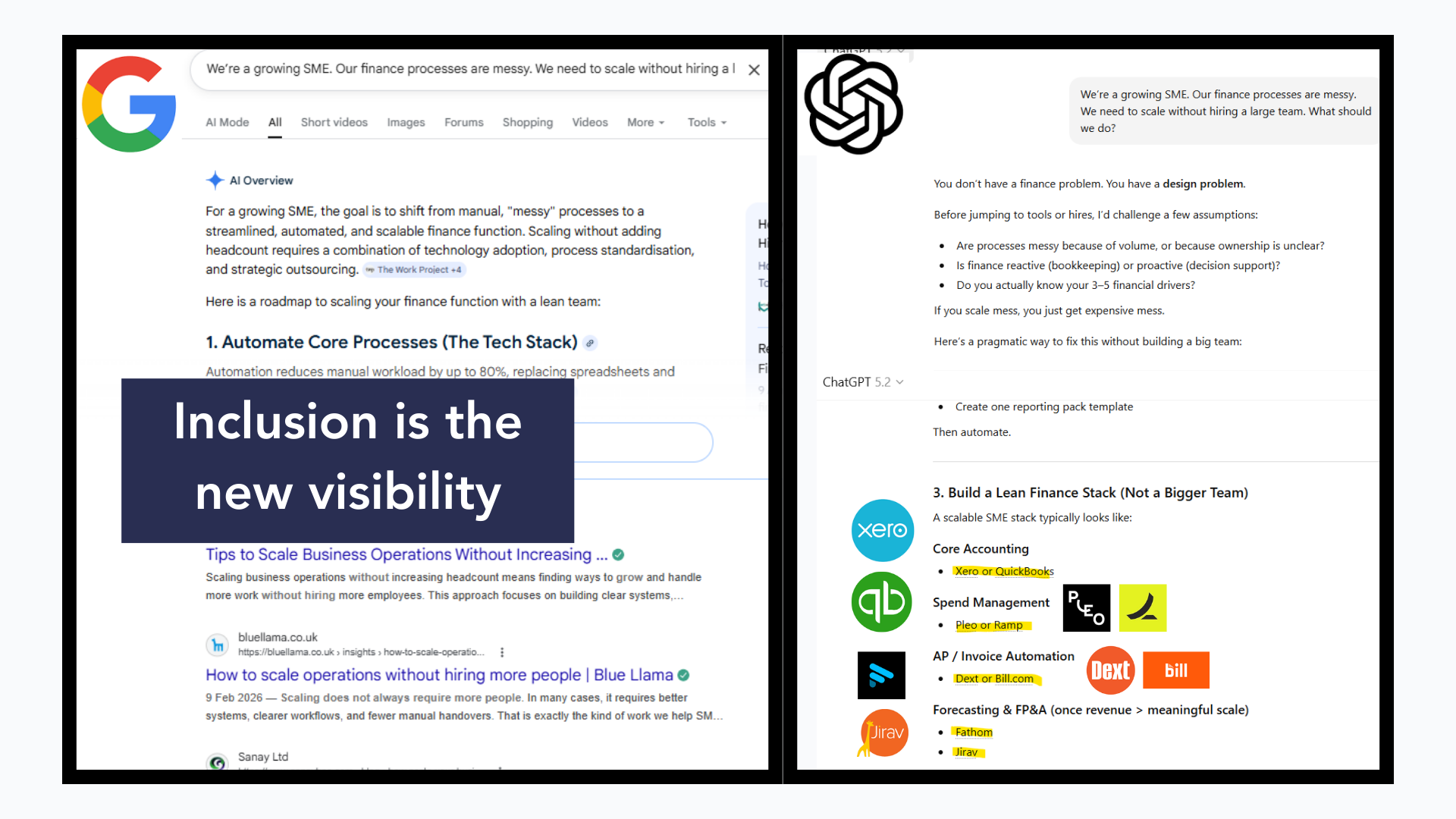
In the past, the goal was simple: appear at the top of the search results page. Today a user might encounter an AI overview, sponsored ads, shopping results, featured snippets, video and local listings — all before a single organic result appears.
In contrast, when a question is asked in an LLM, context is given. In B2B, this could look like: "We're a growing SME. Our finance processes are messy. We need to scale without hiring a large team. What should we do?"
The LLMs do not return a ranked list of pages. They produce a structured response. They interpret the situation, retrieve relevant information, and surface solutions they recognise as credible for that context. Visibility in this environment is not about page position. It is about inclusion in the answer.
Visibility Depends on Credibility Signals
SEO continues to play an important role. Technical SEO ensures your site is structured, accessible, and crawlable. Content SEO ensures your pages address relevant topics with depth and clarity. Those foundations still matter.
However, AI systems do more than match keywords. They retrieve information and evaluate patterns across multiple sources. Brands are more likely to surface when those patterns are consistent and credible.
In practice, that means:
- Clear positioning and defined category language.
- Specific case studies with measurable outcomes.
- Third-party validation through media, analyst coverage, or credible reviews.
- Consistent messaging across website, press, and partner channels.
- Repeated use-case framing that reinforces expertise.
When brands get this right, AI systems recognise them as credible. When brands get this wrong, they are invisible regardless of their traffic.
Why Some Brands Still Miss
Many SMEs continue to focus on content, PR, and SEO without considering AI visibility. Two issues tend to hold them back.
The first is treating this as a keyword problem. Optimising for discoverability alone does not determine inclusion in a synthesised answer. Systems evaluate positioning, proof, reviews, media mentions, and consistency.
The second is delay. Vague positioning repeats across assets over time. That language becomes embedded in website pages, articles, and external references. The longer brands take to address the issue, the harder it will be to correct — requiring updates across multiple touchpoints. Clarity compounds. So does ambiguity.
What This Means Now
When buyers describe their situation and receive a structured response, only a small number of brands are surfaced. Inclusion depends on clarity, consistency, and credible proof across multiple sources.
For founders and SMEs, the work is straightforward:
- Define your category clearly.
- State the problems you solve precisely.
- Show outcomes, not claims.
- Align your messaging across website, press, and partner channels.
This is brand alignment work. It always has been.
AI search has not changed what good brand building looks like. It has made it more visible which brands are clear enough to be recommended.
I had the opportunity to discuss these shifts recently on a panel — the conversation reinforced how quickly buyer behaviour is changing, and how many brands are still underestimating the implications. If this resonates with where your business is right now, I'd love to continue the conversation.